
SMALL HABITS • REAL MOMENTUM • HEALTHIER YOU • ONE DAILY HABIT AT A TIME
Friday Muse
One better question. Every Friday.
For women who
want to stop waiting
and start moving forward . . .
one simple shift at a time.
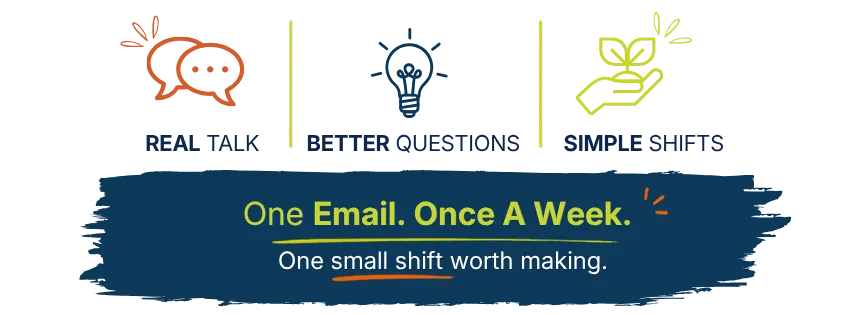
Most newsletters tell you what to do.
Friday Muse helps you think differently first.
Friday Muse
One better question. Every Friday.
For women who
want to stop waiting
and start moving forward .
one simple shift at a time.
Most newsletters tell you what to do.
Friday Muse helps you
think differently first.
What Area Of Your Life Do You Want to Focus On?
You don't have to work on everything at once. Pick the one area that feels most important right now.

I Want To Feel Better
Food. Energy. Aging.
Everyday wellness.
Explore simple ways to take better
care of yourself—one habit at a time.

I Want To Move Forward
Less chaos. Fewer open loops.
More breathing room.
Find practical ideas for making everyday
life feel a little more manageable.

I Want More Freedom
More income. More options.
Something of your own.
Explore realistic ways to start building
more freedom—one step at a time.
What Area In
Your Life Do You
Want to Focus On?
You don't have to work on everything
at once. Pick the one area that feels
most important right now.
I Want To Feel Better
Food. Energy. Aging.
Everyday wellness.
Explore simple ways to take better
care of yourself—one habit at a time.
I Want To Move Forward
Less chaos. Fewer open loops.
More breathing room.
Find practical ideas for making everyday
life feel a little more manageable.
I Want More Freedom
More income. More options.
Something of your own.
Explore realistic ways to start building
more freedom—one step at a time.
Hi. i'm georgina

Why One Daily Habit Exists
Because I have been where you are!
Spent years trying to change everything at once—starting over on Mondays, buying the plans, reading the books, and wondering why I still felt stuck.
Eventually, I started asking a different question.
Instead of:
“How do I fix all of this?”
I started asking:
“What's one small thing I can actually change today?”
Turns out, a better question can give you a very different place to start.
That's the idea behind One Daily Habit.
Not fixing your entire life by Friday.
Just looking at the problem differently, finding one place to begin,
and seeing where one small shift takes you.
Hi! i'm georgina
Why One Daily Habit Exists
Because I have
been where you are!
Spent years trying to change everything
at once—starting over on Mondays,
buying the plans, reading the books,
and wondering
why I still felt stuck.
Eventually, I started asking
a different question.
Instead of:
“How do I fix all of this?”
I started asking:
“What's one small thing
I can actually change today?”
Turns out, a better question can
give you a very different place to start.
That's the idea behind One Daily Habit.
Not fixing your entire life by Friday.
Just looking at the problem differently,
finding one place to begin,
and seeing where one small shift takes you.
Helping women build momentum through better questions and better habits.
Helping women build momentum
through better questions
and better habits.

Maybe the real problem was expecting motivation to do a system’s job.
The Problem Was Never Your Motivation
I have blamed motivation for a lot of things.
The routines I couldn’t maintain.
The plans that looked completely reasonable on Sunday and mildly unhinged by Wednesday.
The healthy habits I started with the enthusiasm of a woman who had clearly forgotten she has a family, responsibilities, and occasionally needs to sit down.
Whenever I stopped, I reached the same conclusion:
I just need to get motivated again.
But here’s the part that doesn’t quite add up.
If motivation were truly the problem, why did I keep starting?
Why did I keep looking for answers?
Why did I keep trying another plan, buying another planner, setting another goal, or promising myself that Monday would be different?
Starting over wasn’t proof that I didn’t care.
It was proof that I did.
Motivation Got You Started
Motivation isn’t useless.
It can help us decide to change, take the first step, and imagine something better.
Enjoyment and intrinsic motivation may also support habit development.
But habits are not built from motivation alone.
Research describes habits as behaviors learned through repetition and connected to recurring cues and contexts. In normal-person language: what surrounds the behavior matters too—not just how badly you want it. Psychology of Habit, Forming a Flossing Habit
That makes sense when you think about it.
Motivation can get you out for one enthusiastic walk.
It cannot guarantee that tomorrow’s schedule will cooperate.
It can inspire you to make a beautiful meal plan.
It cannot prevent Tuesday from behaving like Tuesday.
The problem wasn’t necessarily that your motivation disappeared.
The problem may have been that the plan only worked while your motivation was unusually high.
Your Plan Was Built for Your Best Day
This is where many of us accidentally set ourselves up.
We create plans for the version of ourselves who:
Slept eight uninterrupted hours
Has groceries in the house
Isn’t running late
Has no sick children or unexpected phone calls
Feels energetic, focused, and emotionally stable
Apparently lives alone in a wellness retreat
Then regular life arrives and the plan collapses.
Instead of questioning the plan, we question ourselves.
“I’m inconsistent.”
“I have no discipline.”
“I always quit.”
But a plan that only works under ideal conditions isn’t proof that something is wrong with you.
It may simply be a fragile plan.
Maybe It Wasn’t a Character Flaw
Sometimes we make the first step too large.
Sometimes the behavior has no clear place in our day.
Sometimes there is too much friction between wanting to do something and actually doing it.
Sometimes the goal belongs to a version of life we aren’t currently living.
And yes, sometimes we make a choice we knew would take us farther from what we wanted.
Personal responsibility still matters.
Looking at the real obstacle isn’t an excuse—it’s how we make a more useful decision next time.
Because “I’m lazy” gives you nowhere to go.
“I’m exhausted at the end of the day, and this plan requires an hour I rarely have” gives you something you can work with.
One is a judgment.
The other is information.
The Unspoken Truth About Starting Over
The fact that you keep starting over may not mean you lack motivation.
It may mean you haven’t found a way forward that fits your actual life.
That doesn’t mean every goal should feel effortless. Some things are difficult because they require practice, discomfort, or sacrifice.
But difficult and unnecessarily complicated are not the same thing.
You don’t have to remove every challenge.
You do need to stop using your hardest days as evidence that you’re incapable of change.
The goal isn’t to create a life where you always feel motivated.
The goal is to make the next useful action possible even when you don’t.
One Daily Habit
Choose one thing you’ve been waiting to feel motivated to do.
Then ask:
What is the smallest version of this I could still do on an ordinary day?
Not your most productive day.
Not the imaginary Monday when everyone behaves and the laundry folds itself.
An ordinary day.
Maybe it’s walking for five minutes instead of promising yourself an hour.
Maybe it’s opening the document instead of finishing the project.
Maybe it’s putting one thing away instead of reorganizing the entire house.
Make the step small enough that beginning doesn’t require a motivational speech and background music.
That isn’t lowering the standard.
It’s creating a starting point you can actually use.
Unlearn This
You do not have to feel ready before you begin.
And you do not need to become a permanently motivated person before something can change.
One Better Question
Instead of asking:
Why can’t I stay motivated?
Try asking:
What would make this easier to repeat when I don’t feel motivated?
That question moves you away from judging yourself and toward designing something that has a chance of surviving real life.
Maybe the problem was never that you didn’t want it badly enough.
Maybe motivation was simply being asked to do a job it was never meant to do alone.
A Small Friday Invitation
If you like questioning the advice we’ve all been trying—and blaming ourselves for when it doesn’t work—Friday Muse is where we continue the conversation.
One everyday problem. A different way to look at it. One small shift worth trying.
No complete life overhaul required.



Explore The Blog
Think Differently
Prefer to explore on your own?
Browse practical ideas, better questions,
and simple habits you can actually use.

© COPYRIGHT 2026 Movement Media Group, LLC | ALL RIGHTS RESERVED | TERMS AND CONDITIONS | Affiliate Disclosure | Privacy Policy
© COPYRIGHT 2026 Movement Media Group, LLC ALL RIGHTS RESERVED | TERMS AND CONDITIONS Affiliate Disclosure | Privacy Policy