SMALL HABITS • REAL MOMENTUM • HEALTHIER YOU • ONE DAILY HABIT AT A TIME
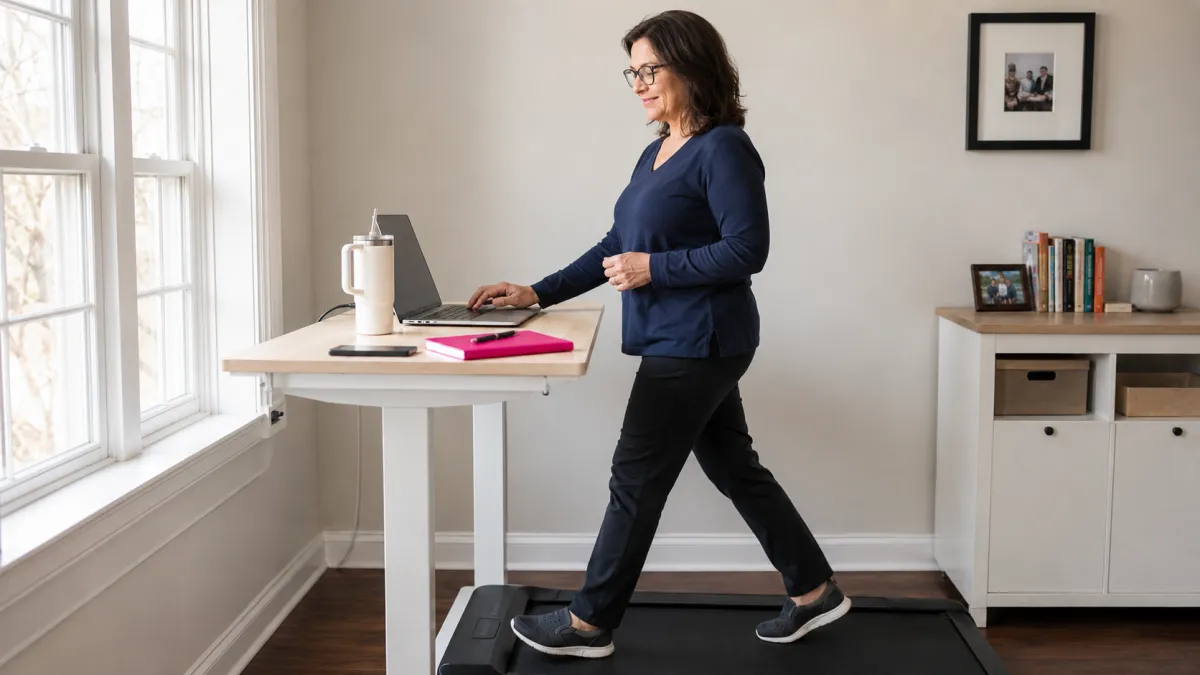
Woman using a walking pad while working at a standing desk at home

How to Make Healthy Habits Easier

July 18, 20269 min read

How Do I Create an Environment Where My Body Wants to Work With Me Instead of Against Me?

For a long time, every plan I tried seemed to begin with the same assumption:

If I had more discipline, it would work.

So when it didn’t work, I knew exactly who to blame.

Me.

If I couldn’t stick to the plan, I needed more motivation.

If the scale didn’t move, I needed to try harder.

If I felt tired, hungry, or frustrated, I assumed I was doing something wrong.

Then I would start over—again.

But lately, I’ve been asking myself a different question:

What if my body isn’t the problem? What if the setup I’m trying to live in isn’t supporting me?

Because a habit can sound perfectly reasonable on paper and still be completely unrealistic inside an actual life.

Especially one that includes a job, a family, responsibilities, interrupted sleep, changing hormones, and approximately 347 things competing for your attention before lunch.

Maybe My Body Isn’t the Enemy

At 51, I’m beginning to question the way I’ve been talking to—and about—my body.

I’ve spent years treating it like an opponent.

Something to control.

Something to shrink.

Something that would finally cooperate if I could just follow the rules long enough.

But health and weight are influenced by much more than food and exercise. Sleep, medications, health conditions, genetics, daily habits, and where we live and work may all play a role. (NIDDK)

That doesn’t remove personal responsibility.

It gives us a more complete picture of what we’re working with.

This isn’t another promise that rearranging the pantry will magically fix everything.

It probably won’t.

The cookies are powerful, but they are not running the entire operation.

It’s about recognizing something simpler:

The conditions surrounding our choices matter.

It is harder to make a thoughtful food choice when you have waited until you’re starving.

It is harder to move your body when the only workout you consider “good enough” requires an uninterrupted hour.

It is harder to go to bed earlier when nighttime is the first part of the day that finally belongs to you.

Those aren’t necessarily excuses.

They may be clues.

I Stopped Trying to Change Myself and Changed the Setup

For a long time, I believed exercise had to look like a proper workout.

I needed workout clothes, a designated time, a complete routine, and enough enthusiasm to leave the house voluntarily.

The problem was that my real life didn’t consistently have room for that.

Then I bought a walking pad and placed it under my desk.

I didn’t need to create an entirely new routine. I could walk while doing work I was already going to do.

Before using it, I generally averaged around 4,000 to 5,000 steps a day.

One day, I reached more than 9,000 steps. On another, I had already walked 2,800 steps by 9:00 in the morning.

Those numbers don’t establish a long-term trend. I’m still collecting information, and I don’t know yet what effect this will have on my health, weight, or body composition.

But the walking pad showed me something useful:

When a supportive choice fits my real life, I am far more likely to make it.

The walking pad didn’t give me more willpower.

It removed a barrier.

Your Environment Is More Than Your Kitchen

When we hear the word environment, we often think about our physical surroundings.

What food is in the refrigerator?

Are our walking shoes where we can see them?

Did we fill the water cup before sitting down to work?

Those things can help, but our environment is bigger than what’s sitting on the counter.

It includes:

  • Our schedules

  • Our energy

  • Our responsibilities

  • Our sleep

  • The options available to us

  • The support we have

  • The expectations we place on ourselves

  • How difficult we make a habit before we allow it to count

A habit that works inside a calm, flexible, well-rested life may fall apart inside a busy and unpredictable one.

That doesn’t automatically mean the person failed.

Sometimes the habit and the life were simply a mismatch.

What If I Added Support Before I Removed More?

Most health plans begin with subtraction.

  • Eat less.

  • Cut this.

  • Stop that.

  • Avoid everything you enjoy and somehow remain delightful to be around.

There may be valid reasons to reduce certain foods or change certain behaviors.

But after years of beginning with restriction, I’m trying to start with a different question:

What could I add that would make this choice more supportive?

Could I add something to a meal that helps it feel more complete?

Could I keep water nearby so hydration doesn’t require another decision?

Could I add movement to something I’m already doing?

Could I add a little more sleep instead of expecting caffeine and determination to carry the entire operation?

I’m not saying addition is always the answer.

I’m saying it deserves a place in the conversation.

I don’t want every attempt to care for my body to begin with another list of things I’m no longer allowed to have.

I want to begin with support.


One Simple Habit I Added

One small habit I’ve incorporated into my life is drinking a packet of --> NingXia Red each day.

I started drinking it in April, and what I appreciate most is how uncomplicated it is.

I can drink it chilled, take a packet with me, or add it to something I already enjoy. I don’t need to measure anything or pull out three appliances before I’ve fully opened my eyes.

I am not claiming that --> NingXia caused a particular change in my health. It isn’t a magic fix, and my experience cannot guarantee anyone else’s results.

It is simply one supportive choice I’ve made easy enough to repeat.

Sometimes the most sustainable habit isn’t the most impressive one.

It’s the one that fits.

Disclosure: I’m a Young Living Brand Partner. If you purchase through my link, I may earn a commission at no additional cost to you. I only share products I personally use, but my experience is not a guarantee of results.


I’m Learning to Treat Information as Information

I’m also experimenting with something that doesn’t come naturally to me:

Collecting information without immediately turning it into a verdict.

I used to treat every measurement—weight, steps, glucose, inches—as proof that I was either succeeding or failing.

Now I’m trying to see those numbers for what they are:

Information.

They may help me notice patterns. They may help me ask better questions. Some may eventually be useful when I speak with my doctor.

But they are not a daily grade on my worth.

I don’t have to turn every number into a courtroom drama starring me as the defendant.

Sleep Belongs in the Conversation

Sleep used to feel like something I would work on after everything else was finished—which is adorable, considering everything else is never finished.

Now I’m paying more attention to it.

Research has connected insufficient sleep with changes in appetite and food cravings. In one randomized trial reported by the National Institutes of Health, adults who usually slept fewer than 6.5 hours and then increased their sleep consumed fewer calories on average. That does not mean sleeping longer automatically produces weight loss, but it does suggest sleep deserves a place in the conversation. (NIH)

So instead of immediately asking:

What is wrong with me?

I can also ask:

How did I sleep?

Did I wait too long to eat?

Was I stressed or rushed?

Was the supportive option easy to reach?

Was the plan realistic for the day I was actually having?

The goal isn’t to excuse every choice.

It is to understand what influenced it.

Support Doesn’t Guarantee Results

Here is the uncomfortable truth:

I can improve my environment and still not get the exact result I want.

I can walk more and not immediately lose weight.

I can sleep longer and still wake up tired sometimes.

I can make supportive choices and still have health concerns that require professional care.

I am living in a human body—not a machine that produces guaranteed results when I insert enough good habits.

Support is not control.

It simply makes the choices I want to make a little easier to repeat.

And right now, that feels far more useful than another plan built around how long I can tolerate being miserable.

Maybe Cooperation Looks Different Than I Thought

I used to think my body “working with me” meant getting the result I wanted on the timeline I wanted.

Now I think it might look like something quieter:

Choices that fit my actual life.

Routines that survive ordinary days.

Information without immediate judgment.

More curiosity and less criticism.

I am still figuring this out.

I don’t know what my next lab work or InBody scan will show. I cannot confirm which changes are responsible for any differences I notice because I am experimenting with several things at once.

What I do know is that I’m tired of treating my body like an opponent.

Maybe I don’t need to force it into submission.

Maybe I need to get better at listening, learning, and creating conditions that make supportive choices easier.

That doesn’t solve everything.

But it gives me a much better place to begin.


One Daily Habit

Before demanding more discipline from yourself today, ask:

What could I change around me that would make my next supportive choice easier?

Fill the water cup.

Move the shoes closer to the door.

Decide what you might eat before you’re starving.

Walk for a few minutes instead of waiting for an open hour.

Turn something off and go to bed a little earlier.

You don’t have to rebuild your entire life today.

Just make one helpful choice easier to reach.


One Small Idea, Once a Week

If this gave you a better question to ask, you might enjoy Friday Muse.

Every Friday, I send one small, thought-provoking idea to help you see an ordinary problem a little differently. No productivity guilt. No elaborate homework. Just one idea worth carrying into the week.

Join Friday Muse


This article shares my personal experience and is provided for general educational purposes only. It is not medical advice and should not replace care or guidance from a qualified healthcare professional.


Georgina

Georgina

Mom of three. Hot cocoa reheater. Recovering perfectionist. I believe the biggest breakthroughs don't come from doing more—they come from seeing things differently. Around here we challenge old thinking, build better habits, and take one small step toward a healthier, richer, more intentional life... one daily habit at a time.

Back to Blog

A Quick Note: The information shared on One Daily Habit is for educational and informational purposes only. It is not intended to replace medical, nutritional, legal, financial, or other professional advice. Every person and situation is unique, so always consult a qualified professional before making decisions about your health, finances, or other important matters. Any products, resources, or recommendations shared are offered to educate and inspire—not as guarantees of specific results.

A Quick Note: The information shared on One Daily Habit is for educational and informational purposes only. It is not intended to replace medical, nutritional, legal, financial, or other professional advice. Every person and situation is unique, so always consult a qualified professional before making decisions about your health, finances, or other important matters. Any products, resources, or recommendations shared are offered to educate and inspire—not as guarantees of specific results.

Woman using a walking pad while working at a standing desk at home

How to Make Healthy Habits Easier

July 18, 20269 min read

How Do I Create an Environment Where My Body Wants to Work With Me Instead of Against Me?

For a long time, every plan I tried seemed to begin with the same assumption:

If I had more discipline, it would work.

So when it didn’t work, I knew exactly who to blame.

Me.

If I couldn’t stick to the plan, I needed more motivation.

If the scale didn’t move, I needed to try harder.

If I felt tired, hungry, or frustrated, I assumed I was doing something wrong.

Then I would start over—again.

But lately, I’ve been asking myself a different question:

What if my body isn’t the problem? What if the setup I’m trying to live in isn’t supporting me?

Because a habit can sound perfectly reasonable on paper and still be completely unrealistic inside an actual life.

Especially one that includes a job, a family, responsibilities, interrupted sleep, changing hormones, and approximately 347 things competing for your attention before lunch.

Maybe My Body Isn’t the Enemy

At 51, I’m beginning to question the way I’ve been talking to—and about—my body.

I’ve spent years treating it like an opponent.

Something to control.

Something to shrink.

Something that would finally cooperate if I could just follow the rules long enough.

But health and weight are influenced by much more than food and exercise. Sleep, medications, health conditions, genetics, daily habits, and where we live and work may all play a role. (NIDDK)

That doesn’t remove personal responsibility.

It gives us a more complete picture of what we’re working with.

This isn’t another promise that rearranging the pantry will magically fix everything.

It probably won’t.

The cookies are powerful, but they are not running the entire operation.

It’s about recognizing something simpler:

The conditions surrounding our choices matter.

It is harder to make a thoughtful food choice when you have waited until you’re starving.

It is harder to move your body when the only workout you consider “good enough” requires an uninterrupted hour.

It is harder to go to bed earlier when nighttime is the first part of the day that finally belongs to you.

Those aren’t necessarily excuses.

They may be clues.

I Stopped Trying to Change Myself and Changed the Setup

For a long time, I believed exercise had to look like a proper workout.

I needed workout clothes, a designated time, a complete routine, and enough enthusiasm to leave the house voluntarily.

The problem was that my real life didn’t consistently have room for that.

Then I bought a walking pad and placed it under my desk.

I didn’t need to create an entirely new routine. I could walk while doing work I was already going to do.

Before using it, I generally averaged around 4,000 to 5,000 steps a day.

One day, I reached more than 9,000 steps. On another, I had already walked 2,800 steps by 9:00 in the morning.

Those numbers don’t establish a long-term trend. I’m still collecting information, and I don’t know yet what effect this will have on my health, weight, or body composition.

But the walking pad showed me something useful:

When a supportive choice fits my real life, I am far more likely to make it.

The walking pad didn’t give me more willpower.

It removed a barrier.

Your Environment Is More Than Your Kitchen

When we hear the word environment, we often think about our physical surroundings.

What food is in the refrigerator?

Are our walking shoes where we can see them?

Did we fill the water cup before sitting down to work?

Those things can help, but our environment is bigger than what’s sitting on the counter.

It includes:

  • Our schedules

  • Our energy

  • Our responsibilities

  • Our sleep

  • The options available to us

  • The support we have

  • The expectations we place on ourselves

  • How difficult we make a habit before we allow it to count

A habit that works inside a calm, flexible, well-rested life may fall apart inside a busy and unpredictable one.

That doesn’t automatically mean the person failed.

Sometimes the habit and the life were simply a mismatch.

What If I Added Support Before I Removed More?

Most health plans begin with subtraction.

  • Eat less.

  • Cut this.

  • Stop that.

  • Avoid everything you enjoy and somehow remain delightful to be around.

There may be valid reasons to reduce certain foods or change certain behaviors.

But after years of beginning with restriction, I’m trying to start with a different question:

What could I add that would make this choice more supportive?

Could I add something to a meal that helps it feel more complete?

Could I keep water nearby so hydration doesn’t require another decision?

Could I add movement to something I’m already doing?

Could I add a little more sleep instead of expecting caffeine and determination to carry the entire operation?

I’m not saying addition is always the answer.

I’m saying it deserves a place in the conversation.

I don’t want every attempt to care for my body to begin with another list of things I’m no longer allowed to have.

I want to begin with support.


One Simple Habit I Added

One small habit I’ve incorporated into my life is drinking a packet of --> NingXia Red each day.

I started drinking it in April, and what I appreciate most is how uncomplicated it is.

I can drink it chilled, take a packet with me, or add it to something I already enjoy. I don’t need to measure anything or pull out three appliances before I’ve fully opened my eyes.

I am not claiming that --> NingXia caused a particular change in my health. It isn’t a magic fix, and my experience cannot guarantee anyone else’s results.

It is simply one supportive choice I’ve made easy enough to repeat.

Sometimes the most sustainable habit isn’t the most impressive one.

It’s the one that fits.

Disclosure: I’m a Young Living Brand Partner. If you purchase through my link, I may earn a commission at no additional cost to you. I only share products I personally use, but my experience is not a guarantee of results.


I’m Learning to Treat Information as Information

I’m also experimenting with something that doesn’t come naturally to me:

Collecting information without immediately turning it into a verdict.

I used to treat every measurement—weight, steps, glucose, inches—as proof that I was either succeeding or failing.

Now I’m trying to see those numbers for what they are:

Information.

They may help me notice patterns. They may help me ask better questions. Some may eventually be useful when I speak with my doctor.

But they are not a daily grade on my worth.

I don’t have to turn every number into a courtroom drama starring me as the defendant.

Sleep Belongs in the Conversation

Sleep used to feel like something I would work on after everything else was finished—which is adorable, considering everything else is never finished.

Now I’m paying more attention to it.

Research has connected insufficient sleep with changes in appetite and food cravings. In one randomized trial reported by the National Institutes of Health, adults who usually slept fewer than 6.5 hours and then increased their sleep consumed fewer calories on average. That does not mean sleeping longer automatically produces weight loss, but it does suggest sleep deserves a place in the conversation. (NIH)

So instead of immediately asking:

What is wrong with me?

I can also ask:

How did I sleep?

Did I wait too long to eat?

Was I stressed or rushed?

Was the supportive option easy to reach?

Was the plan realistic for the day I was actually having?

The goal isn’t to excuse every choice.

It is to understand what influenced it.

Support Doesn’t Guarantee Results

Here is the uncomfortable truth:

I can improve my environment and still not get the exact result I want.

I can walk more and not immediately lose weight.

I can sleep longer and still wake up tired sometimes.

I can make supportive choices and still have health concerns that require professional care.

I am living in a human body—not a machine that produces guaranteed results when I insert enough good habits.

Support is not control.

It simply makes the choices I want to make a little easier to repeat.

And right now, that feels far more useful than another plan built around how long I can tolerate being miserable.

Maybe Cooperation Looks Different Than I Thought

I used to think my body “working with me” meant getting the result I wanted on the timeline I wanted.

Now I think it might look like something quieter:

Choices that fit my actual life.

Routines that survive ordinary days.

Information without immediate judgment.

More curiosity and less criticism.

I am still figuring this out.

I don’t know what my next lab work or InBody scan will show. I cannot confirm which changes are responsible for any differences I notice because I am experimenting with several things at once.

What I do know is that I’m tired of treating my body like an opponent.

Maybe I don’t need to force it into submission.

Maybe I need to get better at listening, learning, and creating conditions that make supportive choices easier.

That doesn’t solve everything.

But it gives me a much better place to begin.


One Daily Habit

Before demanding more discipline from yourself today, ask:

What could I change around me that would make my next supportive choice easier?

Fill the water cup.

Move the shoes closer to the door.

Decide what you might eat before you’re starving.

Walk for a few minutes instead of waiting for an open hour.

Turn something off and go to bed a little earlier.

You don’t have to rebuild your entire life today.

Just make one helpful choice easier to reach.


One Small Idea, Once a Week

If this gave you a better question to ask, you might enjoy Friday Muse.

Every Friday, I send one small, thought-provoking idea to help you see an ordinary problem a little differently. No productivity guilt. No elaborate homework. Just one idea worth carrying into the week.

Join Friday Muse


This article shares my personal experience and is provided for general educational purposes only. It is not medical advice and should not replace care or guidance from a qualified healthcare professional.

Back to Blog

A Quick Note: The information shared on One Daily Habit is for educational and informational purposes only. It is not intended to replace medical, nutritional, legal, financial, or other professional advice. Every person and situation is unique, so always consult a qualified professional before making decisions about your health, finances, or other important matters. Any products, resources, or recommendations shared are offered to educate

and inspire—not as guarantees of specific results.

Friday Muse

One better question. Every Friday.

For women who

want to stop waiting

and start moving forward . . .

one simple shift at a time.

Most newsletters tell you what to do.

Friday Muse helps you think differently first.

Friday Muse

One better question. Every Friday.

For women who

want to stop

waiting and start

moving forward . . .

one simple shift

at a time.

Most newsletters tell you what to do.

Friday Muse helps you think differently first.

SEE WHAT PEOPLE HAVE SAID ABOUT WORKING WITH ME *

★★★★★

Praesent mattis, ipsum sit amet placerat dapibus, est eros tempor neque, nec elementum dui ipsum non elit.

JANE AWESOME, ACME CO.
★★★★★

Curabitur feugiat lacinia orci, non rutrum quam dignissim ac. Donec laoreet bibendum ligula, ullamcorper consectetur dolor

JANE AWESOME, ACME CO.
★★★★★

Eros tempor neque, nec elementum dui ipsum non elit. Curabitur feugiat lacinia orci, non rutrum quam dignissim consectetur dolor

JANE AWESOME, ACME CO.

© COPYRIGHT 2026 Movement Media Group, LLC | ALL RIGHTS RESERVED | TERMS AND CONDITIONS | Affiliate Disclosure | Privacy Policy

© COPYRIGHT 2026 Movement Media Group, LLC | ALL RIGHTS RESERVED | TERMS AND CONDITIONS | Affiliate Disclosure

Privacy Policy